Suggested Reading
Interview
Evergreen
Karl Sims & Alexander Mordvintsev on Merging Technology and Biology
Peter Bauman
•
August 31, 2026
View


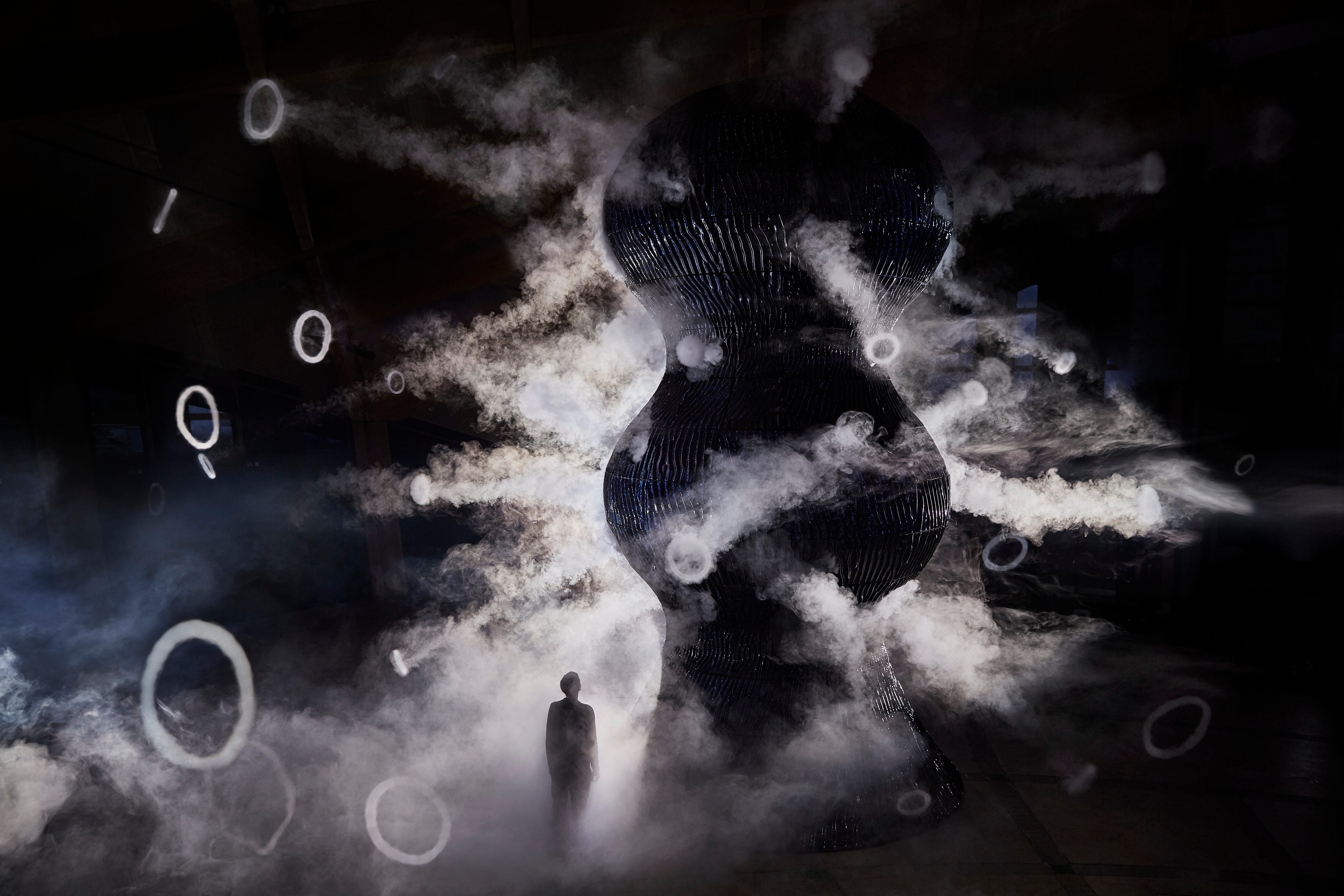
Artist duo A.A.Murakami spoke with Peter Bauman (Monk Antony) about creating screenless immersive art and technology installations, where existence itself is the medium. Their solo exhibition New Nature opens September 1, 2026 at Paradise City Art Space, Seoul.
Peter Bauman: When I see your work manipulating fog, I’m reminded of Fujiko Nakaya and E.A.T.'s Pepsi Pavilion at Expo '70 in Osaka. Much like yourselves, Nakaya and E.A.T. were both envisioning new relationships between art, science, nature and engineering. What do you take from that lineage?
A.A.Murakami: Even though we work with fog as well, there's something about the way that we use fog that is intrinsically different in its nature from Nakaya’s. We don't seek to recreate natural phenomena like weather.
Our work is distinct from artists like Nakaya or Olafur Eliasson, who are more recreating fog or rainbows. But our work isn’t the kind of phenomena that happen naturally. You don't get bubbles shedding from trees and the clouds like we make with our giant fog bubbles. They aren't really like clouds that you get in nature.
They feel natural because they're still taking place within the laws of nature. So they are of course very natural because they're natural phenomena but they're almost like unnatural phenomena. We're not really creating weather when we use fog. Ours are more vortexes, fog rings.
What we want to do is express a kind of life in our installations.
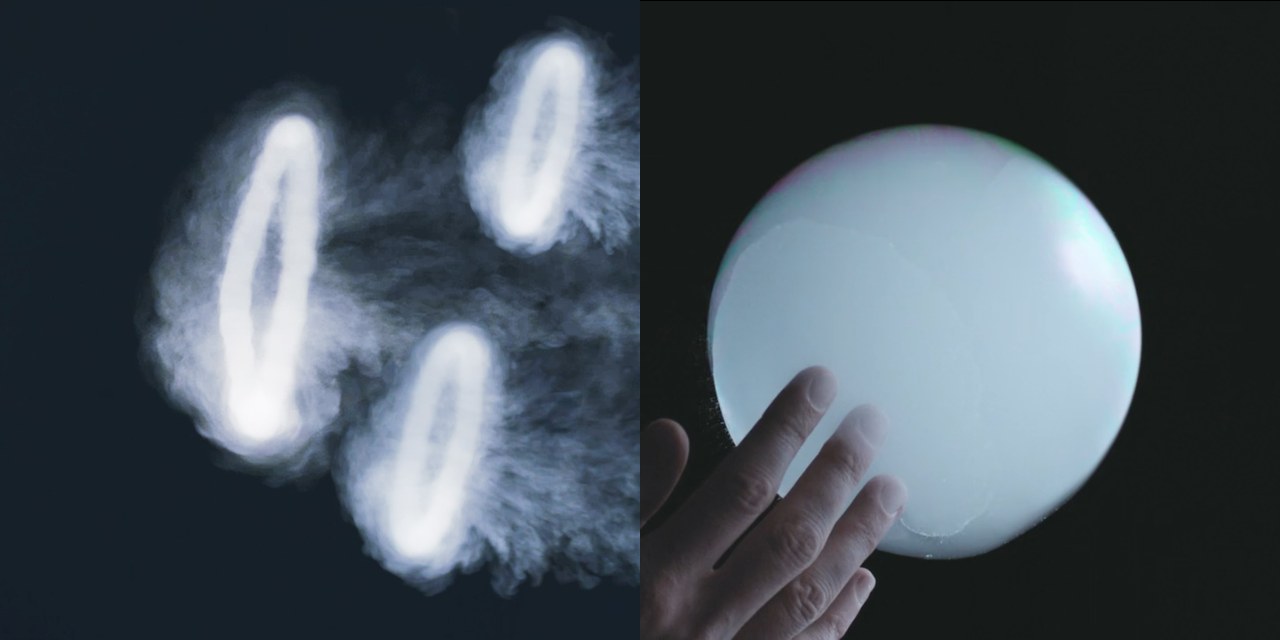
If you look at living systems and life, there are two aspects of it. One is a constant flow of energy to keep something alive, a metabolism. Within every cell in our body we’ve got these ATP, a constant flow of chemical energy made by a proton gradient.
The other aspect of life is a membrane, a cell. The bubbles, for example, don't have constant energy flowing into them. They're known as metastable in that nature's created a kind of membrane.
The earliest cells were thought to actually maybe have started in bubbles and evolved into cells.
The fog rings express life's other nature, this flow of energy. The fog rings have no membrane. There's no barrier between the air and the gas that's swirling in the vortex. The only thing that's holding that pattern together is energy.
You can see when the energy isn't feeding in, it slows down, loses momentum and just unravels; it loses its identity and dissolves into fog.
Bubbles and fog rings both express something that's almost alive, a living thing. It's coming into and slipping out of existence but almost as a pattern or order. I'm really interested in that.
Peter Bauman: Nakaya also typically conceals any sign of machinery.
A.A.Murakami: We tend to have the technology in the space as well, seeing the machines making the giant bubbles, or most recently with the project for BMW, seeing the technology and the natural phenomenon that it's creating.
I'm really interested in what slips out of the digital world—the information, the chips—into the physical realm, into these bubbles that then dissolve. What is it that slips away after that?
There's something for us about that idea of witnessing something slipping between these states but also questioning what is it that's slipping. Is it order itself? Because life itself is interesting in the sense that it seems to defy the second law of thermodynamics, of entropy itself. It’s that the universe goes from a more ordered to a less ordered state, usually by the dispersion of heat.
Yet life seems to get ever more complex through highly improbable combinations of things: simple cells evolving four billion years ago to complex forms of life like dinosaurs, giraffes, dragonflies, to the technology that this life creates on Earth, like iPhones and satellites.
If you discovered an iPhone on another planet, you'd say the only way that could possibly get there is if life was involved. The expected waiting time of those atoms combining through chance far exceeds the lifespan of the whole universe.
But life gets it there because while it seems to buck the trend of entropy it's actually exporting more heat and more disorder into the universe so it's actually speeding up entropy.
The best analogy is if you pour cream into coffee, it will make these fractal patterns, these little spirals. We know that the coffee is eventually going to go all homogenous, disordered, brown, but between the states of the milk going into the coffee it will make these little patterns of order. They're actually little mechanisms to speed up the stirring and to speed up the entropy.
In a way the sun is pouring its white light into the blackness of space and life is like the little eddies and fractal patterns that form in that change of order.
Peter Bauman: Fascinating. I co-wrote a piece with Primavera De Filippi where we argue art has been slowly acquiring the components of life. I think your practice demonstrates this. How does your relationship with objects explain the difference between Studio Swine and A.A.Murakami?
A.A.Murakami: Studio Swine is our design practice and A.A.Murakami is our art practice. Alex studied fine art; Azusa studied architecture and we both met on a master's in product design at the Royal College of Art (RCA).
When we first graduated in 2011, we began Studio Swine, an experimental design space. We did all these projects which were very much born out of our influences at RCA.
We had these fantastic tutors like Jurgen Bey, a Dutch designer who was very into narrative design as a tool for storytelling. We started out by doing all these projects which were very driven by our love of materials and love of going to different countries. We would find really unique design language and objects that were completely born out of the geography, the history, everything that creates these really distinct things.
We went to live in São Paulo and did a few projects in Brazil, like making our own foundry on the streets of the city to melt down aluminium cans. Or we went into the Amazon rainforest and worked with wild rubber. We went to Shanghai and worked with human hair; there’s this big human hair market we went to research.
The films were as much an output of the projects as the objects were, films like International Geographic. So we were really exploring new sustainable materials and very into that.
Then in 2017 we got an opportunity to do a project for COS in Milan, where we showed New Spring for the first time. It was just going to be on for a week and we really felt it was about making an experience. So we made this tree that sheds these mist-filled bubbles. The bubbles were ephemeral so everyone could hold something and get something.
At the same time we didn’t go there to make a product to sell; it was about giving people an experience and an ephemeral object.
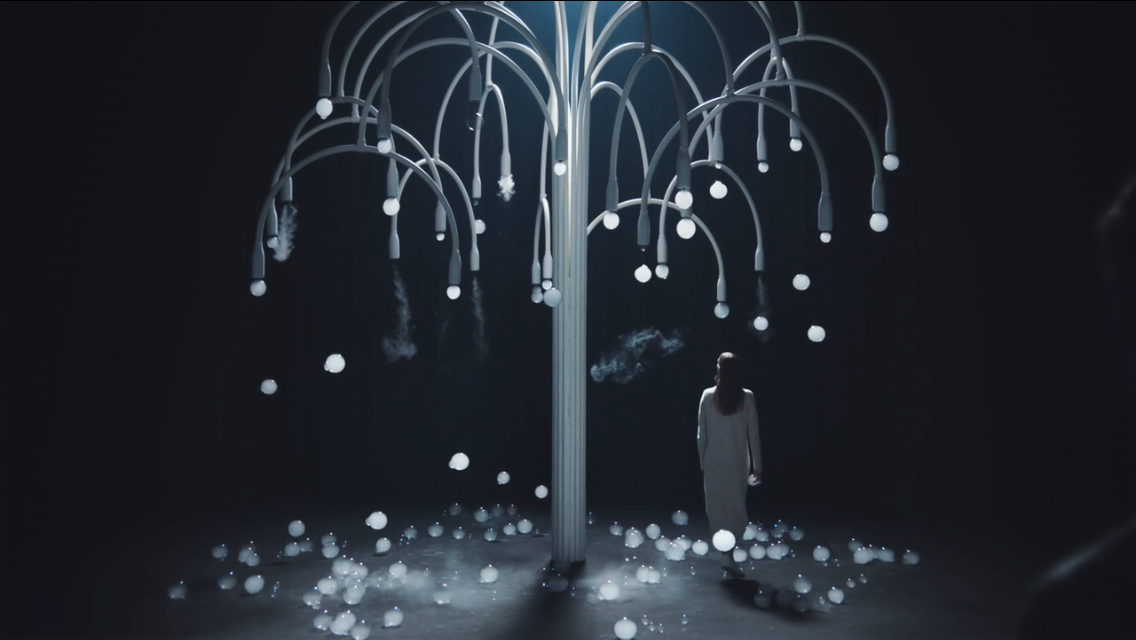
We recognized that those kinds of works were actually more suited to an art context. So we made an art studio called A.A.Murakami that would just specialize in what we now call ephemeral tech.
They're two different ways of thinking really. Now, looking back, you can see patterns and connect the dots, but at the time you're just really following a certain instinct, desire, curiosity.
We're always drawn back to the physics of life in a way. The ephemeral work gives you the movement of light in space. As James Turrell said, “Light is not so much something that reveals, as it is itself the revelation.”
Light is Turrell’s subject matter. It's his medium; light itself is the matter that he's working with. In our case, with these ephemeral tech installations, it's existence itself.
You're watching something coming into and out of existence, very aware of the intangible.
There's a feeling, a philosophy in Japan of mono no aware, the feeling you get from the awareness and beauty of impermanence. It's a sweet sadness that you can witness in the observation of the cherry blossom. There's that sensibility in the work. That's why we define it as a new movement.
Peter Bauman: You mentioned ephemeral tech and maybe you can say more about what it can achieve. It’s grounded in an aversion to screens, projections, LEDs and the familiar technological interfaces that dominate art and technology.
A.A.Murakami: The main thing is that when you're looking at the digital realm through a screen or projection, there's a sense that it's not subject to the same physical laws you are.
Of course on some level it is subject to entropy but it's kind of deathless. Rather than immortal, I'd use the word deathless. We’re really interested in how we hand over control to natural laws. It goes into a material, into forces of nature, into a state of matter, whether that's liquid, gas or plasma. It's subject to intermolecular forces and gravity.
When you're looking at nature, like the cherry blossom and it's falling, you're very much aware that it's a transient moment. It's not something you can pause, rewind, come back to two years later.
It's happening now; it's a fleeting moment and you're a fleeting moment in the great span of the universe; you're sharing this one thing that will never come again.
Studies have shown that the fact that we know that we can record things makes our memory worse. You save a photo and it's more forgettable. We think that applies to the experience of art actually.
We don't mean to disparage digital art because we think there are people that do apply wonderful human creativity to it. It's just not something that we do really. We don't see ourselves as digital artists.
Our deep love has always been materials, right from when we were doing Studio Swine as well. They have a certain sensation even if you're not touching them and feeling them: the way that they interact with light, the textures and everything. It speaks to something very primordial in us and gives you a feeling that is almost before language.
Peter Bauman: You’re having a busy year with eight shows running or opening in 2026: Venice, Basel Unlimited, Copenhagen, Barcelona, Mumbai, Arnhem and two in Seoul, with New Nature opening at Paradise Art Center in September. What does this moment feel like from inside the studio? Is there a thread connecting it all?
A.A.Murakami: I'd say it's our busiest year. It always feels busier and busier every year. We started A.A.Murakami in 2020 and every year we've been building it. Last year was twelve shows in twelve months, including Floating World, our first solo show in the US at Museum of Fine Arts, Houston.
This year’s on track to be more than that. The big focus actually is: we've been building up all these ephemeral tech works, going further and further with that as a body of work, but we've been starting this new body of work, which we don’t actually have a name for yet.
It’s based on the idea that life makes patterns; it's almost like patterns are alive themselves. We've got this generative artwork, A Thousand Layers of Stomach, that has been taking the form of textiles with this knitting machine we made.
In Venice we're showing this giant knitted tapestry from that series. Then these paintings are going in the Seoul Paradise City show. They're continuing this generative pattern that's derived from clamshells but this plotting machine is making these paintings essentially out of mud.
The seashells take calcium from the sea and reorganize it, like a 3D printer, into these very beautiful patterns and very perfect shell structures. In a sense this mud plotter is taking mud and reorganizing it into patterns. So it's something to do with life as a kind of pattern generator.
We keep mining our generative code for this pattern and keep changing the parameters and it's almost like every time we do we get surprised with what comes out. It's almost like it's alive in a way. You really get a feeling that this is how evolution is so amazing at making so much variety.
We're just working on a very basic level, but you get a glimpse into evolution, if you had four billion years and way more parameters. It's that process of life ratcheting up complexity through Darwinian evolution.
This is very new for our studio because the outcomes are very physical. They're textiles, they're paintings; they're almost like traces of life, just as the seashells are. Behind the seashell is a very dynamic ephemeral process and all of these things that we talk about with ephemeral tech, but the result is physical.
Peter Bauman: That connection between life and patterns reminds me of the Eileen Gu bubble dress from the Met Gala. What did you learn from the experience and do you have any more plans in fashion?
A.A.Murakami: Normally, you set up a show, you've got days. You're testing it and the opening is a crucial moment. But a dress is a few minutes on the red carpet, one shot. It has to be really smooth, work perfectly.
You've compacted the technology down as small as possible to be inside this dress. There's a five-kilogram tank of helium she's wearing under the dress and one of the bubbles is secretly a button that she presses. One glass bubble that looks like everything else has a pressure sensor that activates the bubbles. Everything's entirely custom. It was really a fantastic experience.
That's the second bubble dress we made actually. The first one we made last year was for a show in Tokyo that Chanel had supported, about le19M, which is this amazing collection of heritage ateliers that Chanel owns and supports, heritage French companies making buttons and tweed, very haute couture crafts Chanel saved and supports.
We made a bubble dress for that show, too, but it was different: the bubbles emerged and slid down the dress.
After developing the technology more, we really wanted to do it in something wearable, so we approached Iris [van Herpen] with the technology and the desire to do a dress. It was a wonderful collaboration.
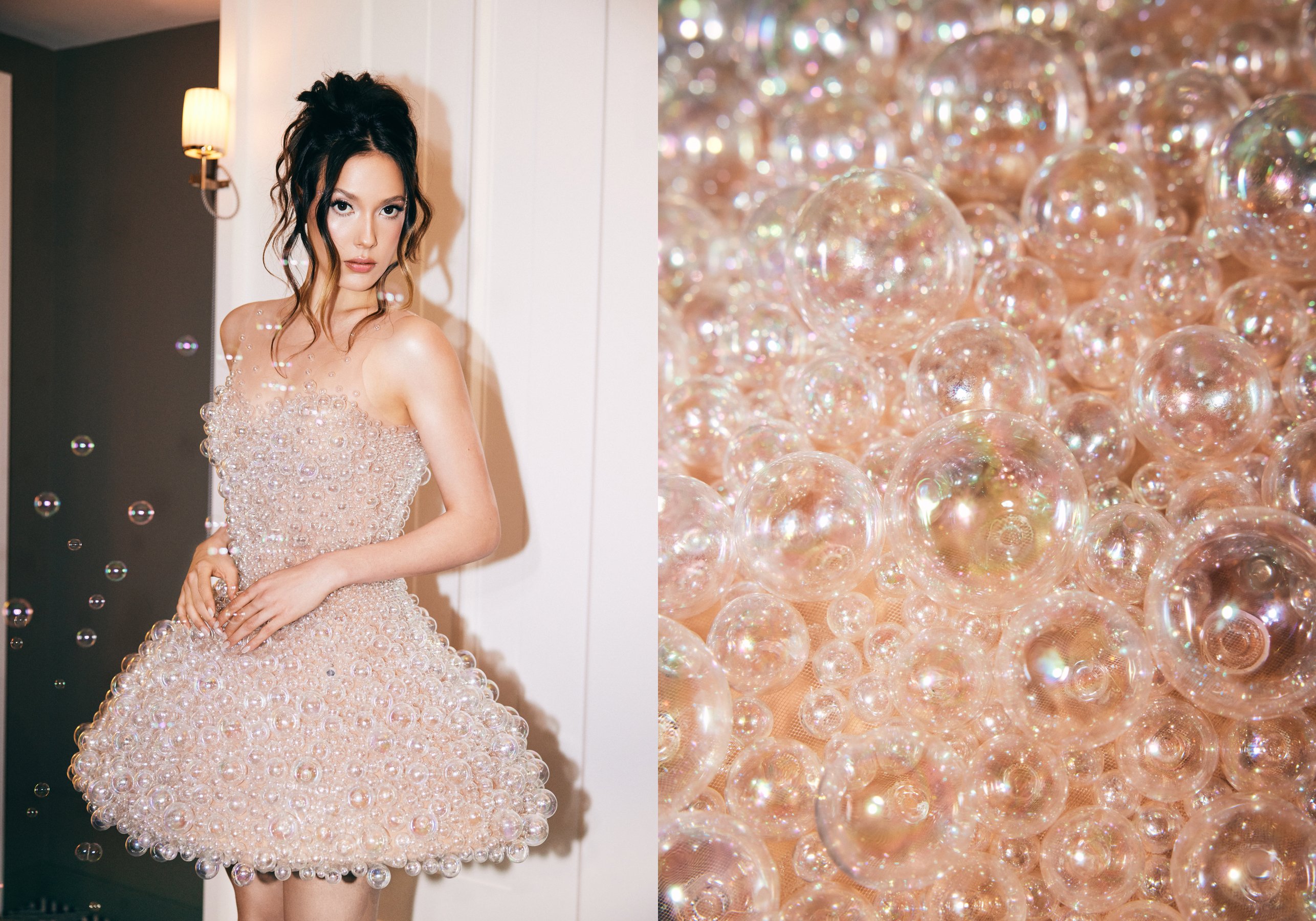
She designed a silhouette and the dress that this technology sat within. We very much wanted to do it for the Met Gala and create this fleeting moment. We were then lucky that Eileen Gu wanted to wear it. She studied physics and flies through the air so she's the perfect person to wear this piece.
Peter Bauman: Beyond fashion, wearable objects and the seashell textile and paintings, how else do you see your practice expanding?
A.A.Murakami: We're quite interested in the idea of meeting people in different places. We're talking to spas, for example. That's quite interesting, to meet audiences in totally different areas where you might be submerged in water.
Peter Bauman: We’ve talked a lot about the relationship in your practice to life, to what extent do you see yourselves as worldbuilders? How do you think about it?
A.A.Murakami: We really like the idea of bringing projects together into a journey where you enter a world essentially that you're going through. We really love traditional Chinese gardens, like Suzhou with these water gardens where you go through rooms that are almost outdoor. They're a kind of harmony of architecture and nature.
They connect to the earthly and the cosmos and they connect poetry, like a Gesamtkunstwerk; they're completely synthesizing all these things. We’ve always wanted our solo shows to be navigable room by room, where you go through these different spaces, these different environments.
We did that in Floating World (2025) and we've got solo shows planned for 2027, where audiences go through different spaces with overarching themes.
We want it to feel like you're walking around a Chinese water garden in a sense, going between the earthly and the cosmic realms through these experiences.
------
A.A.Murakami is an artist duo known for their sensory installations exploring the connection between art and nature. Pioneers of ephemeral tech, the duo’s work is featured in the permanent collections of MoMA (New York), Centre Pompidou and M+.
Peter Bauman (Monk Antony) is Le Random's editor in chief.